01
Private accounts
Your account starts on your device. There is no email address and no conventional password: the app creates your account keys itself, and a new device is added only when the device that created the account approves it.
- No email or phone number
- Keys created on your device
- New devices by approval
02
Private routing
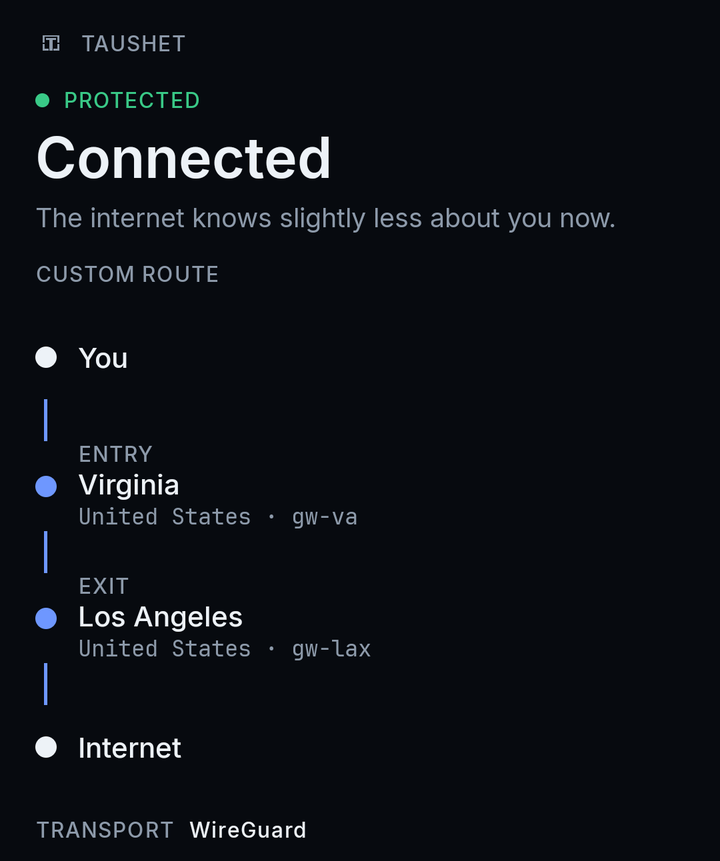
Your device picks the route itself, from a signed server list. One server when speed matters most, or two, so your traffic enters and leaves through different servers.
- Fast
- One server, chosen for you.
- Private Route
- Two servers, chosen automatically: the exit is in a different region from the entry where one is available.
- Custom Route
- You choose the entry and the exit.
03
Compartmentalized infrastructure
Each part of the service gets only what it needs. A VPN server admits your connection with a short-lived credential that names no account. The account service is reached over Tor, so it does not see your IP address. Payments do not exist yet; they are designed so the payment side never needs your account ID.
- Account service over Tor
- Account-less server credentials
- Payments kept apart, by design
04
Privacy-focused network
WireGuard tunnels, a kill switch, and DNS kept inside the tunnel. The VPN servers run a signed image from memory, and a restart erases what that runtime held; the account and credential services run from disk. The app checks the server list’s signature before it connects.
- WireGuard
- Kill switch and leak protection
- VPN servers run from memory